
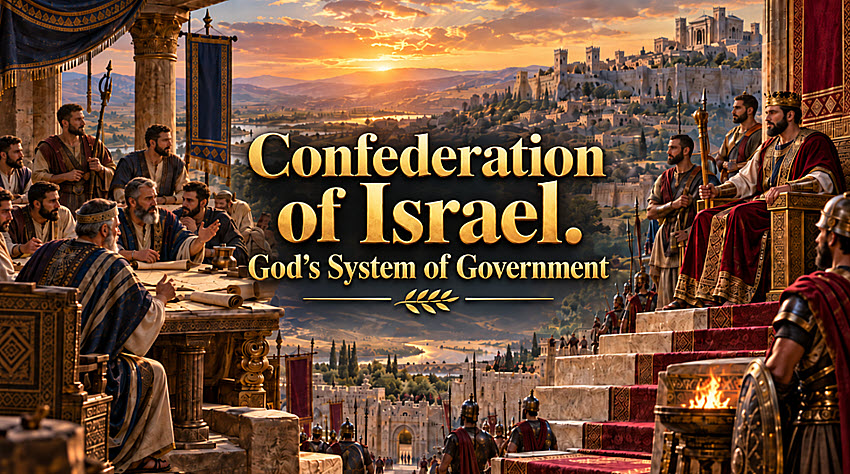
Government in Israel—what system of rule does God approve?
Various political and economic systems exist in the world. The Bible depicts several different ways in which authority was exercised in Israel.
However, the most important question is not merely who ruled, but above all: who—according to God—should be the supreme Ruler? Who establishes the law, and what authority should one human being have over others?
Let us clarify the terminology right away: Israel. This name identifies the people of God described in the Old and New Covenants (the Old and New Testaments). The current jewish state—which calls itself Israel—has appropriated this name. They seek to convince the world that they are the chosen people—that is, the Biblical Israel.
This is a perfidious lie. These impostors are jews; therefore, they should properly be referred to as the jewish state. The word „Jew” does not appear in the Bible. The Scriptures speak of Hebrews, Israelites, and Judeans. There are no „Jews.” That term was invented later. The word „Jew” aptly characterizes Judaism, which the Apostle Paul described as an adversary of God:
„For you have heard of my former conduct in judaism—how I persecuted the assembly of God beyond measure and tried to destroy it.” — Galatians 1:13.
Current systems of power
Communism
Communism entails a very strong role for the state and the restriction or abolition of private ownership of the means of production.
In practice, communist states were most often ruled by a single party that controlled:
• politics,
• the economy,
• the media,
• the military,
• a large part of social life.
Power was thus heavily concentrated in the hands of the state and the party.
Socialism
Socialism entails a greater role for the state in the economy and increased state responsibility for the distribution of goods and social welfare.
The state may control or own certain enterprises, services, and infrastructure.
Socialism can exist within both democratic and more authoritarian systems.
Capitalism
Capitalism is primarily an economic system.
Its foundations are:
• private property,
• private enterprises,
• trade,
• competition,
• the ability to accumulate wealth.
The state can have a greater or lesser influence on the economy, depending on the specific country.
Capitalism can function under various political systems.
Democracy
Democracy presupposes that citizens participate in the selection of those who hold power.
Most often, people elect:
• parliament,
• the president,
• local authorities,
• other representatives.
In a representative democracy, the people do not make most decisions directly but instead elect individuals to make decisions on their behalf.
Communism, socialism, and capitalism largely concern the organization of the economy and property, whereas democracy primarily defines the manner in which political power is selected and exercised.
What systems of government existed in Israel?
1. The Patriarchs—Abraham, Isaac, and Jacob
Before the establishment of the State of Israel, the fundamental structure was the family and the clan. A patriarch stood at the head of the family.
Abraham held real authority over his household and was responsible for its management. However, Abraham was not the ultimate lawgiver.
It was God who determined what was good and right.
The system can be illustrated as follows:
- God → patriarch → family and home
2. Moses — The Rise of a Nation
After the Israelites left Egypt, the situation changed.
A nation bound by a covenant with God came into being.
Moses was:
• leader of the nation,
• judge,
• mediator of the covenant,
• transmitter of the Law.
But Moses did not create the law according to his own will.
The law came from God.
This is a very important difference between this system and an ordinary human state. However, Moses was not to bear the entire responsibility for the nation alone. God instructed him to gather seventy elders of Israel:
“Gather for me seventy men from among the elders of Israel, whom you know to be elders of the people and their officers” — Numbers 11:16.
God said that they would share the burden of the people with Moses, so that he would not have to bear it alone — Numbers 11:17.
A group of 70 elders also appears earlier — Exodus 24:1, 9.
This shows that there was a group of elders alongside Moses who bore a special responsibility for the entire nation. The Bible presents them as a select group of elders supporting Moses in his responsibility for the people.
3. Elders and Overseers—Division of Responsibility
Initially, Moses settled a great many matters himself. Jethro observed that such a system was inefficient. Therefore, Moses was to appoint capable, honest, and God-fearing men as leaders.
The Bible lists four levels:
• superiors over 1,000,
• superiors over 100,
• superiors over 50,
• superiors over 10.
The description is found in Exodus 18:21–26 and Deuteronomy 1:15.
At the highest level, this structure can be presented as follows:
God → Moses → commanders of 1,000 → of 100 → of 50 → of 10 → the people
Alongside this structure, there were also 70 elders of Israel who were to share responsibility for the nation with Moses.
This illustrates an important principle: authority and responsibility were separated.
Moses was not expected to handle every matter himself. Lesser cases were resolved at a lower level, while more difficult ones were referred to a higher authority.
To illustrate this, if we consider a group of 1,000 people and analyze all the levels mathematically, we get the following:
• 1 overseer of 1,000,
• 10 overseers of 100,
• 20 overseers of 50,
• 100 overseers of 10.
Together, this would amount to:
1 + 10 + 20 + 100 = 131 officials.
However, it must be added here: the Bible does not state that for every exactly 1,000 people, there were exactly 131 different officials.
The text lists the organizational levels: thousands, hundreds, groups of fifty, and tens.
However, it does not explain precisely:
• whether each unit was always mathematically nested within the next,
• whether all functions were performed by different individuals,
• whether certain superiors could simultaneously belong to other groups of elders and leaders.
The power structure was as follows:
- God → Moses → many elders and leaders → the people.
Moses did not handle everything alone. Responsibility was shared among many people, yet all were subject to a single Law originating from God.
4. Yesu, son of Nun — leader after Moses
After the death of Moses, responsibility for the nation fell to Yeshu/Yesu, son of Nun (whose name was changed to Joshua).
He was not a king. He was a leader appointed for a specific task.
He had:
• lead Israel into the Promised Land,
• lead the nation during battles,
• participate in the division of the land among the tribes.
Elders and tribal leaders continued to function.
The system can be represented as follows:
- God → Yesu, son of Nun → elders and leaders → tribes → families.
5. Judges — no permanent king
After the death of Yesu, Israel did not appoint a single, permanent king. The nation consisted of tribes that had their own elders and leaders. When a threat arose, God raised up judges.
Among them were:
• Othniel,
• Ehud,
• Deborah,
• Gideon,
• Jephthah,
• Samson.
The judge was not a king holding permanent dynastic power. He was often a leader appointed at a specific moment to save the nation.
The system can be described as:
- tribes + elders + judges raised up by God.
6. Gideon rejects hereditary rule
The Israelites wanted Gideon to become their ruler, followed by his son and grandson. This would have meant the establishment of a dynasty.
Gideon refused.
“I will not rule over you, nor will my son rule over you. YHWH will rule over you.” — Judges 8:23.
Gideon pointed out who should be the supreme Ruler of Israel.
Not a man.
God.
7. Israel Demands a King
Later, a huge change took place. The elders of Israel came to Samuel and demanded a king. They wanted to have a king, just like the other nations.
Then God said to Samuel:
„It is not you they have rejected, but Me they have rejected, that I should not reign over them” — 1 Samuel 8:7.
The issue was not merely the establishment of the office of king. Israel wanted a system similar to that of the surrounding nations. It wanted a human king as the visible ruler of the nation.
8. Saul — the first king
Saul became the first king of Israel. The period of the monarchy began.
The system now looked different:
- God → king → officials and leaders → the people.
Yet the king was still not the supreme legislator. The king himself was subject to the Law of God.
9. God limited the king’s power.
Deuteronomy 17:14–20 shows that the king could not do whatever he pleased.
Above all, the king was to be a leader of the nation subject to God and His Law.
His duties included, among other things:
• leading the nation,
• ensuring state security,
• leading the nation in wartime,
• administering justice and upholding fairness,
• directing state administration,
• maintaining order within the country.
David was presented as the one who was to shepherd the people of Israel and be their leader—2 Samuel 5:2.
Solomon asked God for wisdom so that he could judge the people and distinguish between good and evil — 1 Kings 3:9.
The king therefore held great power, but it was not absolute power. Deuteronomy 17:14–20 imposed specific limitations upon him.
The king:
• he was to know the Law of God,
• he was to possess a copy of it,
• he was to read it all the days of his life,
• he was to learn to fear God,
• he was to observe the commandments,
• he was not to amass horses in excess,
• he was not to accumulate many wives,
• he was not to amass silver and gold in excess,
• he was not to exalt himself above his brothers.
The king was not the source of the law.
He could not arbitrarily change God’s principles simply because he was king.
He himself had to submit to the same Law that governed the people. Nor was he the owner of the nation or its land.
He was a ruler and leader accountable to God.
That is why prophets could stand up to the king when he violated the Law. Samuel rebuked Saul. Nathan rebuked David. Elijah confronted Ahab.
This demonstrates that the king was subject to the Law; the Law was not subject to the king.
God remained the Supreme Ruler.
10. David and Solomon — the United Monarchy
After Saul, David became king. Later, Solomon assumed power. At that time, Israel functioned as a single kingdom.
It was:
• king,
• administration,
• commanders,
• judges,
• priests,
• elders.
But even the king was not above God. A prophet could stand up to the king. The king could be punished. The king could also be rejected by God.
Ultimate authority still rested with God.
11. Division of the kingdom
After the death of Solomon, the kingdom was divided.
Two states were formed:
• Judah — in the south,
• Israel — in the north.
Both had kings. In Judah, the Davidic dynasty endured. In northern Israel, dynasties changed frequently. Yet, prophets continued to speak out against kings whenever they violated God’s Law.
This demonstrates once again that the king was not the ultimate authority.
12. Assyria and Babylon — Loss of Independence
The northern kingdom of Israel, comprising ten tribes, was conquered by Assyria.
The Bible shows that this was not merely a political outcome. God rejected northern Israel because of its unfaithfulness, idolatry, and spiritual harlotry.
„And YHWH was very angry with Israel and removed them from His presence; no one remained except the tribe of Judah alone” — 2 Kings 17:18.
The prophets compared Israel’s turning away from God to prostitution and adultery, because the nation abandoned God and turned to other gods—Jeremiah 3:6–10; Ezekiel 16; Ezekiel 23.
Later, the remaining two tribes associated with the kingdom of judah followed a similar path.
God declared:
“I will also remove Judah from my sight, just as I removed Israel” — 2 Kings 23:27.
Judah was subsequently conquered by Babylon. Jerusalem was captured, and the Temple was destroyed.
Thus, God first rejected the ten tribes of northern Israel, and later Judah and Benjamin as well, because they too had been unfaithful to Him.
From that point on, Israel ceased to function as an independent monarchy like the one that existed in the time of David.
13. Persia
After Babylon, Persia took power. Cyrus allowed some of the Israelites to return to their land.
The Temple and Jerusalem were rebuilt. However, the former independent monarchy of David was not restored; Israel remained under the rule of the Persian Empire.
Interestingly, Cyrus was called God’s anointed one.
“Thus says YHWH to His anointed, to Cyrus…” — Isaiah 45:1.
This means that God Himself designated Cyrus as His anointed one.
Why?
Because God chose him for a specific task.
Cyrus was to:
• conquer other kingdoms,
• capture Babylon,
• free the people,
• allow the rebuilding of Jerusalem,
• enable the rebuilding of the Temple.
In Isaiah 44:28, God also calls Cyrus His shepherd and says that he will carry out His will. And in Isaiah 45:4, God says that He called Cyrus by name for the sake of Israel. This does not mean that Cyrus was an Israelite or that he knew God the way the prophets did. It means that God used him as an instrument to carry out His plan.
14. The Greeks and Rome
Later, the lands of Israel came under the influence of Greek rulers. Subsequently, Rome took control.
In the time of Christ, the Roman Empire ruled over the land of Israel. Local rulers and local councils of elders also operated there.
The system can thus be simplified:
- • emperor → Roman administration → local rulers → elders and local authorities → the peopleSummary of systems of authority in Israel
|
Period |
System |
|---|---|
| Abraham, Isaac, Jacob | patriarchal system |
| Moses | God as Lawgiver + Moses + hierarchy of superiors |
| Yesu, son of Nun | designated leader + elders |
| The Period of the Judges | tribes + elders + judges raised up by God |
| Saul | beginning of the monarchy |
| David | monarchy |
| Solomon | monarchy |
| After Solomon | two monarchies — Judah and Israel |
| Assyria and Babylon | the rule of a foreign empire |
| Persia | imperial administration |
| Greeks | foreign domination |
| Rome | empire + local rulers |
The history of Israel illustrates several different ways of exercising human authority.
There were:
- • patriarchs,
- • Moses,
- • elders and leaders,
- • Yesu, son of Nun,
- • judges,
- • kings,
- • foreign empires.
But one principle remains unchanged.
God is the supreme Ruler. He is the source of the law. The person exercising authority is also subject to this law.
What model of rule will emerge in the future?
The Bible shows that the future system will be neither a democracy nor a monarchy established by humans.
It will be the Kingdom of God.
• God the Father remains the Supreme Ruler.
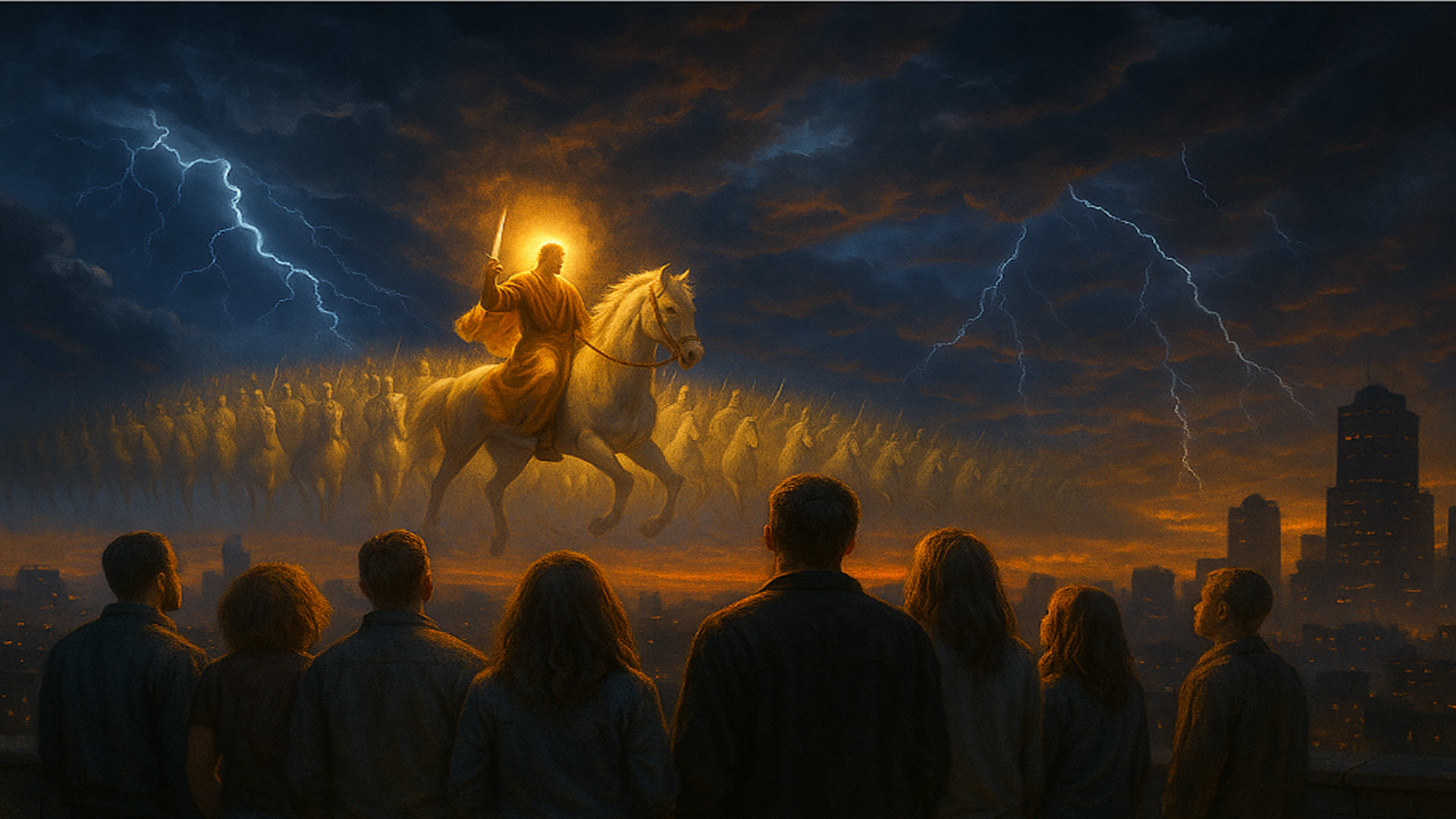
• The Lord Yeshu receives royal authority and reigns as King — Revelation 19:16.
• The saints share in the reign — Daniel 7:27; Revelation 20:4.
• The apostles and saints are to judge the twelve tribes of Israel — Matthew 19:28; 1 Corinthians 6:2–3; Daniel 7:22, 27; Revelation 20:4.
• Ultimately, the Lord Yeshu hands over the Kingdom to the Father and remains subject to Him — 1 Corinthians 15:24–28.
God the Father → Lord Yeshu as King → appointed co-rulers and judges → the nations.
In other words, the future model is the Kingdom of God with a single supreme source of law, authority, and justice, rather than a system in which the people themselves determine what is good and evil.
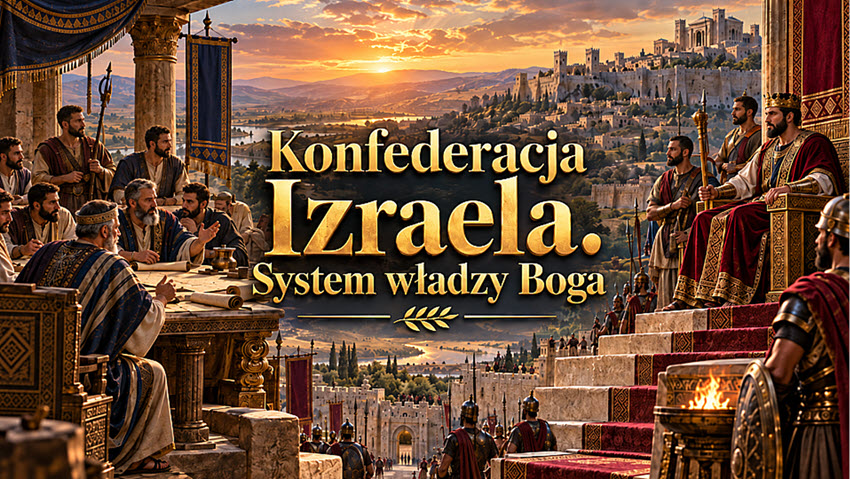
Confederation of Israel — what does it mean?
The word confederation does not appear in the Bible as a designation for Israel’s political system.
It is a modern term that aptly describes how the twelve tribes functioned.
The word itself derives from the Latin confoederatio and signifies a union, alliance, or combination of several communities.
A confederation, then, signifies a union of several distinct communities that retain their own structures but unite under shared principles and for common goals.
This is how ancient Israel can be described.
Israel consisted of 12 tribes.
Each tribe had:
• their own elders,
• their own leaders,
• their own clans and families,
• their own territory,
• their own local organization.
At the same time, all the tribes were united by:
• the same God,
• the same Covenant,
• the same Law,
• common descent from Jacob,
• a common place of assembly and worship,
• joint action in times of danger.
It was not, therefore, a single, highly centralized state entity resembling the later monarchy.
It was, rather, a union of twelve tribes bound by a common Law, a common Covenant, and the supreme sovereignty of God.
Individual tribes could act independently, but in matters concerning the entire nation, they would gather, undertake joint actions, or rally under a common leader.
The period of the Judges serves as a good example.
At that time, there was no permanent human king ruling over all of Israel.
In times of danger, God would raise up a judge to unite the necessary tribes for a common cause.
Hence the term:
„confederation of the twelve tribes of Israel”
It is an apt description of the nation’s organization, but one must bear in mind that it is a modern historical-political term, not a name used directly in the Biblical text.
Put simply:
12 tribes → their own elders and leaders → a shared Law → a shared Covenant → one supreme Ruler — God.
This is precisely what distinguished this system from the later monarchy, when a single human king was established over the entire nation.








Zapraszam do komentowania, wyrażania swojej opinii: