

Table of Contents
≡
1. War in Heaven. The battle against satan. Who won? (Part 1)
2. Who is satan? Was he created? Why does he exist? (Part 2)
3. A rebellion of angels before Eden? Was satan cast out of heaven then? (Part 3)
4. Was he cast down in connection with the death, resurrection, and exaltation of Christ? (Part 4)
5. Will he be cast down only at the end of the period of human rule? (Part 5)
3. A rebellion of angels before Eden? Was satan cast out of heaven then?
Proponents of this view point to the appearance of the serpent in Eden—already an adversary of God, a liar, and a deceiver.
We do not see the moment of his rebellion in the Book of Genesis; we see only its consequences.
Are these proponents correct that satan had already been cast out of Heaven by that time?
Let us see.
3.1 The serpent is already acting against God:
“Now the serpent was more cunning than any of the wild animals that YHWH God had made. He said to the woman: ‘Did God really say that you must not eat from any tree in the garden?’” — Genesis 3:1.
The serpent calls God’s words into question. He suggests that God is not telling the truth and is restricting man.
This shows that, at the moment he speaks to the woman, he is already an adversary of God. He does not rebel only after the sin of Adam and Eve.
His rebellion must have begun earlier.
3.2 The ancient serpent is called satan:
“And the great dragon was hurled down—the ancient serpent called the devil and satan, who deceives the whole inhabited earth”—Revelation 12:9.
John combines four terms:
• a great dragon,
• an ancient serpent,
• the devil,
• satan.
The „ancient serpent” refers to the serpent from Eden.
Therefore, proponents of the first view argue that satan must have fallen before the events described in Genesis 3.
First, he became an adversary of God. Then, he came to man as a deceiver.
3.3 Lord Yeshu says that satan was a liar from the beginning:
„He was a murderer from the beginning, and did not abide in the truth, because the truth is not in him. When he speaks a lie, he speaks from what is his own, because he is a liar and the father of lies” – John 8:44.
The devil:
• did not abide in the truth,
• became a liar,
• was a murderer from the beginning.
The words „did not stand in the truth” may indicate that he was previously in a different state but turned away from the truth.
This is one of the arguments that satan was not created evil. He became an adversary through his own rebellion. However, the verse does not specify the exact time or place of his fall.
3.4 The Fall of the angels
The angels who sinned:
„God did not spare the angels who sinned, but cast them into Tartarus and committed them to chains of darkness, to be kept for judgment” — 2 Peter 2:4.
The angels left their place:
„And the angels who did not keep their original position but abandoned their own dwelling place, He has kept in eternal bonds under darkness for the judgment of the great day” — Jude 1:6.
These verses show that a rebellion of angels actually took place in the spiritual realm.
Angels:
• they sinned,
• they did not keep their position,
• they abandoned their place,
• they have been kept for judgment.
3.5. Isaiah 14
Proponents of the first view also frequently point to Isaiah 14:
„How you have fallen from heaven, O shining one (luminous, brilliant), son of the morning star (son of the dawn, of the morning glow)! You have been cut down to the ground, you who struck down the nations” — Isaiah 14:12.
The figure goes on to say in his heart that he will ascend to heaven, raise his throne, and become like the Most High.
This imagery calls to mind the pride and rebellion of satan.
The issue, however, is that at the beginning of this passage we read:
„You will take up this parable against the king of Babylon” — Isaiah 14:4.
Thus, the text directly concerns the king of Babylon. It is possible that his pride is depicted using language reminiscent of the rebellion of a spiritual being.
However, one cannot definitively establish the date of satan’s fall based on this chapter.
3.6 Ezekiel 28
Ezekiel 28 is used in a similar way.
Character currently in Eden:
“You were in Eden, the garden of God. Every precious stone covered you” — Ezekiel 28:13.
Wickedness has been found:
“You were blameless in your ways from the day you were created, until wickedness was found in you” — Ezekiel 28:15.
This text is sometimes understood as a description of satan’s original state:
• he was created,
• he was blameless,
• he held a high position,
• wickedness was later found in him,
• he was removed from God’s presence.
However, here too, the text is addressed directly to the King of Tyre.
Therefore, while it may contain an image of spiritual rebellion, it is not an unequivocal account of satan’s history.
The biggest problem
The first interpretation explains well why satan is already God’s adversary in Eden. However, it does not adequately explain why satan continues to appear before God after the events in Eden.
The accuser comes before YHWH:
„One day the sons of God came to present themselves before YHWH, and the accuser also came among them” — Job 1:6.
Satan accuses the high priest:
„He showed me Joshua/Yehoshua (Yeshu), the high priest, standing before the messenger of YHWH, and the accuser was standing at his right hand to accuse him” — Zechariah 3:1.
These verses show that, long after Eden, satan can still appear as an accuser before God.
In contrast, Revelation 12 presents a picture from after the war in heaven:
„No place was found for them in heaven anymore.”
This indicates the permanent removal of satan from heaven.
Conclusion
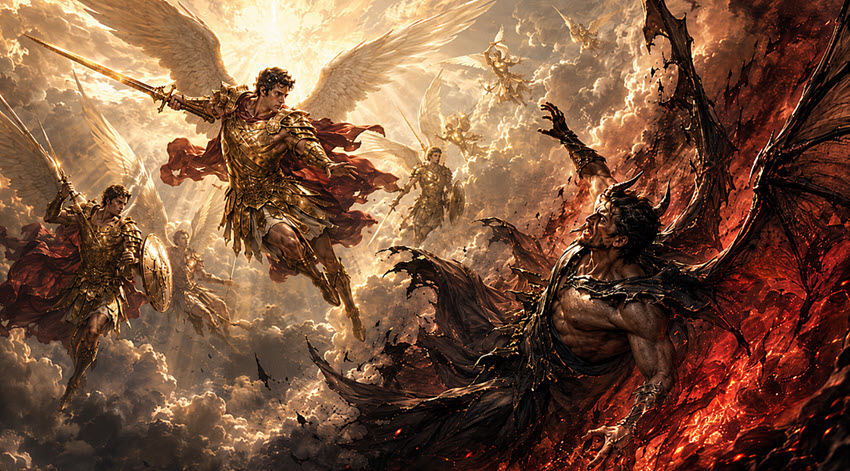
The first view—that satan was cast down prior to deceiving Adam and Eve—rests primarily on the fact that, even in Eden, satan appears as an adversary, a liar, and a deceiver.
However, Job 1–2 and Zechariah 3 show that he continued to accuse people before God at a later time, meaning he had access to the Lord (YHWH).
Therefore, a distinction must be made between two things:
• satan’s initial rebellion before Eden,
• his subsequent complete expulsion from heaven described in Revelation 12.
The first view offers a good explanation for the onset of satan’s rebellion but is less effective at explaining his ultimate casting down to earth.
The Bible indicates that satan was already an adversary and a deceiver prior to the deception of Adam and Eve. However, it does not specify exactly when he began his rebellion. While 2 Peter 2:4 and Jude 6 confirm the sin of the angels, they do not state that it occurred before the events in Eden. Conversely, Job 1–2 and Zechariah 3 show that satan continued to act as an accuser after Eden.
Therefore, his initial rebellion should not automatically be equated with the final expulsion from heaven described in Revelation 12.








Zapraszam do komentowania, wyrażania swojej opinii: