

Table of Contents
≡
1. War in Heaven. The battle against satan. Who won? (Part 1)
2. Who is satan? Was he created? Why does he exist? (Part 2)
3. A rebellion of angels before Eden? Was satan cast out of heaven then? (Part 3)
4. Was he cast down in connection with the death, resurrection, and exaltation of Christ? (part 4)
5. Will he be cast down only during the final period of human rule? (part 5)
4 – Was satan cast down before the death and exaltation of Christ?
4.1 – Even before His death, the Lord Yeshu says that He saw satan falling from heaven…
“He said to them, ‘I saw satan falling from heaven like lightning.’” — Luke 10:18.
The Greek text contains:
- • ἐθεώρουν — etheōroun, Strong G2334 — I was looking, I was observing, I saw,
- • Σατανᾶν — satanan — satan,
- • ἐκ τοῦ οὐρανοῦ — ek tou ouranou — from heaven,
- • πεσόντα — pesonta, from *piptō* — falling, the one who fell.
The Greek *ἐθεώρουν* means „I saw” or „I observed” and is a past-tense form. The Lord Yeshu does not merely say that satan will fall at some point; He says that He saw him falling from heaven. He does not, however, clarify whether this refers to an event that has already taken place or to a prophetic vision of a future defeat.
And, very importantly, Lord Yeshu speaks these words before His death. This is the strongest argument in favor of the view that a fall of satan had already taken place during the earthly ministry of Lord Yeshu.
4.2 – Why did Christ say these words at that particular moment?
We must look at the preceding verse. The disciples return to Christ and say that the demons are subject to them:
“And the seventy-two returned with joy, saying, ‘Lord, even the demons are subject to us in Your name.’” — Luke 10:17.
And it is precisely then that Christ responds:
“I saw satan falling from heaven like lightning” — Luke 10:18.
Then he says:
„Behold, I have given you the authority to tread upon snakes and scorpions, and over all the power of the enemy, and nothing will harm you” — Luke 10:19.
The context is therefore very clear:
• the disciples receive authority,
• demons are subject to them,
• the Lord Yeshu speaks of the fall of satan,
• he then speaks of authority over the power of the adversary.
This may mean that the activity of Christ and His disciples was a real blow to the power of satan. His kingdom was under attack. His demons were being brought into submission in the true name of Christ: Yeshu.
4.3 – Does Luke 10:18 describe the exact same event as the one in Revelation 12?
And here the problem begins. In Luke 10:18, we have a short sentence:
“I saw satan falling from heaven like lightning” — Luke 10:18.
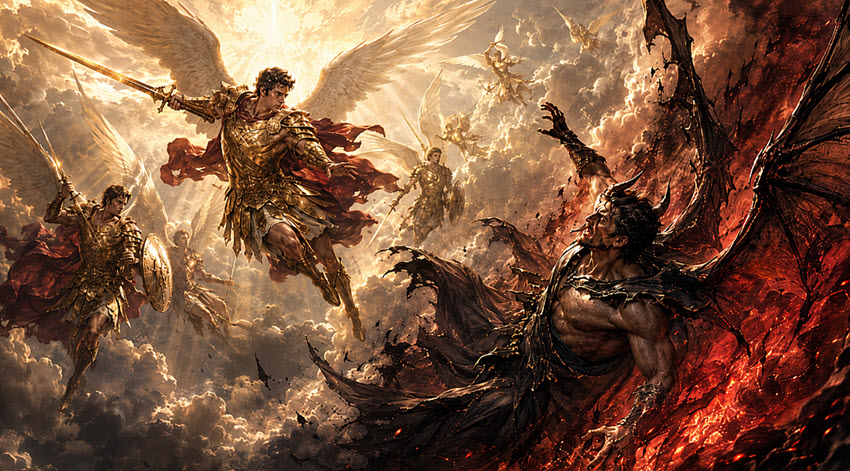
Revelation 12, however, describes much more. After the war in heaven:
• Michael and his angels fight against the dragon (satan),
• the dragon is defeated,
• there is no longer any place for him in heaven,
• satan is cast down to the earth,
• his angels are cast down along with him,
• the accuser loses the ability to accuse people before God,
• satan knows that he has little time.
Particularly important are the words:
“No place was found for them any longer in heaven” — Revelation 12:8.
The Greek word *eti* (ἔτι) here means: any longer, still, or anymore. In other words, the Book of Revelation is not referring merely to a temporary defeat. This war results in a permanent loss of one’s place in heaven.
Luke 10:18 does not convey all of this. Therefore, we cannot automatically conclude:
Luke 10:18 = Revelation 12:7–12.
It could be the same event. But it might also be a reflection—a forewarning of his future downfall, or the first stage of that downfall.
4.4 – A very significant problem: John 12:31
This verse is very important for our topic. The Lord Yeshu speaks these words shortly before His death:
„Now is the judgment of this world. Now the ruler of this world will be cast out” — John 12:31.
We have the future tense here: “will be thrown out.”
This is an important point. The Lord Yeshu speaks of the future casting out of the ruler of this world, even though He had previously mentioned seeing satan fall from heaven. It should be noted, however, that John 12:31 does not specify from where the ruler of this world will be cast out.
The Lord Yeshu does not say, „the ruler of this world has been cast out.”
He says: “he will be cast out.”
This means that while satan may have already been suffering defeat during Christ’s earlier ministry, his casting out was still presented as an event that would take place in the future.
4.5 – Does John 12:31 refer to the same casting down as Revelation 12?
We cannot say this with one hundred percent certainty, either. We cannot state unequivocally that John 12:31 and Revelation 12 describe the exact same event.
John 12:31 says:
“will be thrown outside.”
Revelation 12:9 states more specifically:
“was cast down to the earth”.
In John, it is not stated:
• Michael,
• war in heaven,
• satan’s angels,
• loss of a place in heaven,
• a short time.
Therefore, John 12:31 may speak more broadly of satan’s loss of power and position through Christ’s victory.
However, the future tense remains very important. If Luke 10:18 were to mean that the full and final casting down of satan—as described in Revelation 12—had already taken place, it would be difficult to explain why the Lord Yeshu later says:
„will be thrown out”.
4.6 – Satan has been judged
Even before the death of Christ, another important statement is made:
“And as for judgment—because the ruler of this world has been judged” — John 16:11.
The Greek term *kekritai* (κέκριται) means: he has been judged; a judgment has been passed against him.
The form points to a settled state: the verdict against the ruler of this world has already been rendered.
But this highlights an important distinction:
The issuance of a judgment does not necessarily mean that all its effects have already been carried out.
Satan may already be judged, while his final removal may yet take place at a later time.
This well explains why Christ can simultaneously say:
• regarding the fall of satan,
• regarding the judgment of the ruler of this world,
• and regarding his future expulsion.
We may be dealing with a process of satan’s defeat, rather than a single moment.
4.7 – Revelation 12 describes something more than a mere defeat
“Now have come the salvation and the power and the kingdom of our God and the authority of his Anointed One, because the accuser of our brothers, who accused them before our God day and night, has been thrown down” — Revelation 12:10.
This is a significant event. Satan is not merely being defeated; a certain phase of his activity is coming to an end:
He brought accusations before God — he is cast down.
Therefore, the event described in Revelation 12 appears to be the permanent removal of satan from a position he previously held, rather than merely a symbolic defeat of his power.
4.8 – The most logical explanation of Luke 10:18
Based on the verses themselves, the most cautious explanation is this: during the ministry of Christ, the collapse of satan’s power had already begun.
Demons were being brought into submission by the disciples. The Lord Yeshu saw satan falling from heaven. His kingdom was suffering defeat.
Yet, later on, Christ still says:
“The ruler of this world will be cast out” — John 12:31.
This makes it very difficult to claim that, prior to the death of Christ, satan had already been completely and definitively cast out of heaven in the sense described in Revelation 12.
It is therefore possible that Luke 10:18 depicts:
• the beginning of his downfall,
• a depiction of the loss of power,
• a prophetic vision of his defeat,
• or one of the stages of his removal.
We have no basis for proving, from Luke 10:18 alone, that it was at that very moment that “no place was found for him in heaven.”
Let’s also check the sequence of events.
While still engaged in His earthly ministry, the Lord Yeshu said:
“I saw satan falling from heaven like lightning” — Luke 10:18.
He spoke these words when the disciples returned and reported that even the demons were subject to them in His name (Luke 10:17).
However, later on—shortly before His death—Christ uttered other significant words:
„Now is the judgment of this world. Now the ruler of this world will be cast out” — John 12:31.
Let’s check when these words were spoken:
1. Six days before Passover, the Lord Yeshu arrives in Bethany (John 12:1).
2. The following day, He enters Jerusalem (John 12:12–15).
3. He then states that the hour for the Son of Man to be glorified has come, and He foretells His own death (John 12:23–24).
4. At that very moment, He declares that the ruler of this world “will be cast out” (John 12:31).
5. Immediately afterward, He speaks again of His glorification, and John clarifies that He was referring to the death of Christ (John 12:32–33).
Let us now examine when the Lord Yeshu spoke the words recorded by Luke:
1. Luke describes that the Lord Yeshu decided to go to Jerusalem. This begins with the description of His journey to the city where He was to die (Luke 9:51).
2. During this activity, the Lord Yeshu sends seventy-two disciples to preach and prepare the places where He was to come (Luke 10:1).
3. The disciples return with joy and say that even the demons are subject to them in His name (Luke 10:17).
4. It was then that the Lord Yeshu spoke these words: “I saw satan falling from heaven like lightning” (Luke 10:18).
5. It is only much later in Luke’s account that Christ’s entry into Jerusalem takes place, prior to His death (Luke 19:28–38).
6. It is with this later period that the events described in John 12 are associated—the moment when Christ says, “Now the ruler of this world will be cast out” (John 12:31).
What can be concluded from this?
Luke 10:18 records words spoken earlier, during Christ’s earthly ministry. We do not know the exact number of days or months that elapsed between these statements.
John 12:31, on the other hand, presents words spoken during the final days before His death.
First, the Lord Yeshu says that He saw satan falling from heaven. Later, before His death, He foretells that the ruler of this world is yet to be cast out.
Christ uses the future tense, not the past tense.
However, we cannot automatically assume that both verses describe the exact same event.
Luke 10:18 depicts the fall of satan as witnessed by Christ, whereas John 12:31 foretells his future casting out.
Therefore, we lack sufficient grounds to claim that the complete expulsion of satan and his angels from heaven—as described in Revelation 12:7–12—had already taken place before the death of Christ.











Zapraszam do komentowania, wyrażania swojej opinii: