
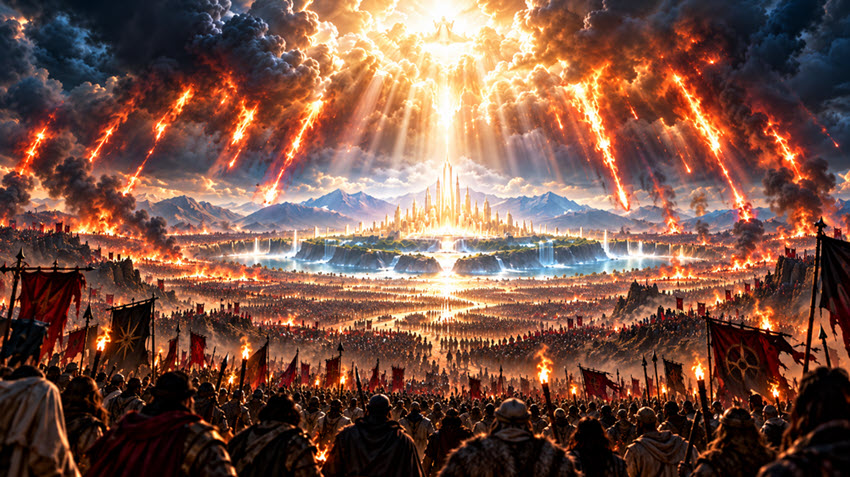
Gog and Magog appear in the Book of Revelation as the final great rebellion of the nations against God.
This takes place only after the thousand-year reign of Christ. At that point, satan is released from his prison; he deceives the nations and leads them into war against the saints.
However, John did not invent the names Gog and Magog. These names appear much earlier in the Bible. First, there is the genealogy of Magog; later, Ezekiel’s prophecy concerning Gog from the land of Magog; and finally, the Book of Revelation employs this imagery to describe the ultimate rebellion against God and His people.
1. Magog — lineage from Noah
Magog appears for the first time in the genealogy of the descendants of Noah.
“The sons of Japheth: Gomer, Magog, Madai, Javan, Tubal, Meshech, and Tiras” — Genesis 10:2.
The pedigree is as follows:
Noah → Japheth → Magog.
The same lineage is confirmed by the First Book of Chronicles:
“The sons of Japheth: Gomer, Magog, Madai, Javan, Tubal, Meshech, and Tiras” — 1 Chronicles 1:5.
Magog is listed as a son of Japheth and a grandson of Noah. Later, the name Magog also comes to be used in reference to a land or a people associated with this lineage.
It is worth noting that Meshech and Tubal are also mentioned alongside Magog in the genealogy of Japheth.
Ezekiel presents Gog as a leader associated precisely with Meshech and Tubal:
“Son of man, set your face against Gog of the land of Magog, the chief prince of Meshech and Tubal, and prophesy against him” — Ezekiel 38:2.
Some of Gog’s allies also come from the lineages of nations that existed after the Flood:
„Persia, Cush, and Put will be with them, all with shields and helmets; Gomer and all his troops, the house of Togarmah from the far north and all his troops—many peoples will be with you.” — Ezekiel 38:5–6.
Gog does not appear alone. He leads a coalition of many peoples, whose names are already known from earlier Biblical genealogies.
2. The Bible also mentions a man named Gog
The name Gog also appears in the genealogy of the tribe of Reuben:
“The sons of Joel: Shemaiah his son, Gog his son, Shimei his son” — 1 Chronicles 5:4.
This shows that Gog was also a common name for a person.
However, we have no grounds to identify this Gog with the Gog from the prophecy of Ezekiel.
3. Gog of the land of Magog — the prophecy of Ezekiel
In the Book of Ezekiel, Gog already appears as a great adversary of God’s people:
“Son of man, set your face against Gog of the land of Magog, the chief prince of Meshech and Tubal, and prophesy against him” — Ezekiel 38:2.
The Bible does not say:
Gog, son of Magog.
It says:
Gog from the land of Magog.
So, in this prophecy:
• Gog is the leader,
• Magog is the land or people associated with him.
In this verse, the Hebrew term *nesi rosh* (נְשִׂיא רֹאשׁ) appears. It can be understood as „chief prince,” but it is also sometimes interpreted as „prince of Rosh.”
God then says:
“And say: Thus says the Lord God: Behold, I am against you, O Gog, chief prince of Meshech and Tubal” — Ezekiel 38:3.
Gog thus becomes an adversary against whom God takes a stand.
4. Gog atakuje lud Boga w dniach późniejszych
Ezekiel shows when this event takes place:
“After many days you will be summoned. In the latter years you will come to a land recovered from the sword, to a people gathered from many nations, upon the mountains of Israel, which had long been desolate.” — Ezekiel 38:8.
Then he says again:
“And you will advance against My people Israel like a cloud covering the land. This will happen in the latter days. I will bring you against My land, so that the nations may know Me, when I show My holiness through you before their eyes, O Gog” — Ezekiel 38:16.
Both verses place Gog in a later period of history.
Gog leads a great coalition against God’s people.
But Gog does not win.
„And it shall come to pass on that day, when Gog comes against the land of Israel—says the Lord God—that My wrath shall rise up in My indignation.” — Ezekiel 38:18.
It is God who acts against Gog.
5. Gog and his armies are destroyed
Ezekiel 39 describes what follows:
“And you, son of man, prophesy against Gog and say: Thus says the Lord God: Behold, I am against you, O Gog, chief prince of Meshech and Tubal” — Ezekiel 39:1.
Next, we read:
“And I will send fire upon Magog and upon those who dwell securely in the islands, and they shall know that I am YHWH” — Ezekiel 39:6.
Gog and his armies are completely defeated.
Ezekiel also provides remarkable details regarding the aftermath of this war.
The weapons left behind by Gog’s armies are to be burned for seven years:
“Then those who live in the cities of Israel will go out and use the weapons for fuel—they will burn the shields and small shields, the bows and arrows, the war clubs and spears—and for seven years they will use them for fuel.” — Ezekiel 39:9.
Next, we read:
“And it will come to pass on that day that I will give Gog a burial place there in Israel, the Valley of the Travelers, east of the sea. It will block the path of those who pass through. There they will bury Gog and all his multitude, and they will call it the Valley of Hamon-Gog.” — Ezekiel 39:11.
The burial of the fallen is set to take seven months:
“The house of Israel will spend seven months burying them, in order to cleanse the land” — Ezekiel 39:12.
Later we read:
“And as those passing through the land travel across it, should one see a human bone, he will set up a marker beside it, until the gravediggers bury it in the Valley of Hamon-Gog.” — Ezekiel 39:15.
The description shows the total destruction of Gog’s army.
6. Gog and Magog appear in the Revelation of John
After many centuries, John uses the same names:
“And when the thousand years are completed, satan will be released from his prison. And he will go out to deceive the nations that are at the four corners of the earth—Gog and Magog—to gather them for war. Their number is like the sand of the sea.” — Revelation 20:7–8.
The text explicitly links Gog and Magog to the nations located at the four corners of the earth; however, Revelation 20:8 itself does not definitively clarify whether these are merely names of those nations or if they also refer to the leaders or the primary forces behind this rebellion.
John draws these names from Ezekiel 38–39. In Ezekiel, Gog is a leader associated with the land of Magog, while Magog denotes the land or people connected to this rebellion.
In Revelation, this imagery is expanded to include the nations from the four corners of the earth, who are deceived by satan and gathered for war against the saints.
7. The Final Attack on the saints
The next verse shows the purpose of this rebellion:
„And they marched across the breadth of the earth and surrounded the camp of the saints and the beloved city. And fire came down from God out of heaven and consumed them.” — Revelation 20:9.
This shows that Gog and Magog are not defeated by ordinary warfare. God puts an end to their rebellion.
The pattern is as follows:
satan deceives the nations → Gog and Magog gather for war → they surround the saints → God destroys the rebels.
This is the final rebellion of the nations against God.
8. Ezekiel and Revelation show a similar pattern
The account in Ezekiel and the account in Revelation bear very clear similarities.
In both places, we find:
• a great number of adversaries,
• a gathering of nations,
• an attack against the people of God,
• direct intervention by God,
• the complete destruction of the attackers.
The similarity is even stronger, because Ezekiel also speaks of fire and sulfur:
“And I will enter into judgment with him with pestilence and with blood; I will rain down torrential rain, hailstones, fire, and sulfur upon him, upon his troops, and upon the many peoples who are with him” — Ezekiel 38:22.
In Revelation, Gog and Magog are also destroyed by fire:
“And fire came down from God out of heaven and consumed them” — Revelation 20:9.
And immediately afterwards, satan is thrown into:
“lakes of fire and sulfur” — Revelation 20:10.
This is another clear parallel between the vision of Ezekiel and the Revelation of John.
One can also observe a similar sequence of events in parts of both books.
In Ezekiel, we find:
Ezekiel 37 → restoration and revival → Ezekiel 38–39 → Gog and war → Ezekiel 40–48 → a new order, the temple, and the land.
In the Revelation of John:
Revelation 20 → restoration and resurrection, the thousand years, and Gog and Magog → Revelation 21–22 → a new heaven, a new earth, and the New Jerusalem.
This does not mean that every detail in both accounts is identical, but the arrangement of events shows a clear similarity.
However, there is also an important difference.
In Ezekiel, Gog comes:
“from your place, from the farthest north, you and many peoples with you” — Ezekiel 38:15.
In Revelation, however, the rebellion encompasses a much broader scope:
“the nations that are at the four corners of the earth, Gog and Magog” — Revelation 20:8.
In Ezekiel, the direction is specified as the north, whereas in Revelation, we find the nations of the whole earth.
Therefore, Ezekiel 38–39 creates a picture to which Revelation 20 explicitly refers.
This does not necessarily mean, however, that every detail describes the exact same event.
What matters most is the underlying pattern: the rebellion of nations against God ends in their destruction by God.
9. Revelation 19 also alludes to Ezekiel 39
Ezekiel describes a great feast for the birds following the destruction of Gog’s armies:
“And you, son of man, thus says the Lord God: Speak to every kind of bird and to all the wild beasts: Gather together and come; assemble from all around for the sacrifice that I am preparing for you—a great sacrifice on the mountains of Israel. You shall eat flesh and drink blood” — Ezekiel 39:17.
“You shall eat the flesh of the mighty and drink the blood of the princes of the earth […] At my table, you shall feast until you are full on horses and riders, on mighty men and all kinds of warriors” — Ezekiel 39:18–20.
A very similar image appears in the Revelation of John even before the beginning of the thousand years:
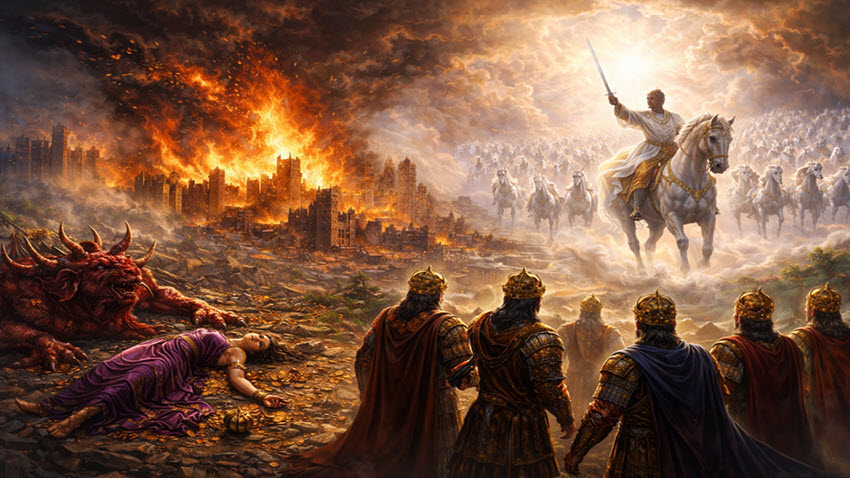
“And I saw an angel standing in the sun. And he cried out with a loud voice to all the birds that fly in midheaven: ‘Come, gather together for the great feast of God, to eat the flesh of kings, the flesh of commanders, the flesh of mighty men, the flesh of horses and those who sit on them, and the flesh of all—both free and slave, small and great.’”—Revelation 19:17–18.
This shows that the Revelation of John draws upon imagery from Ezekiel 38–39, and not only in the passage concerning Gog and Magog in Revelation 20.
The motif from Ezekiel also appears earlier, in connection with the destruction of the beast and the armies gathered against Christ.
10. Gog and Magog are not the beast
In Revelation 13, the beast is granted permission to wage war against the saints and to defeat them:
“And it was granted to her to wage war against the saints and to conquer them” — Revelation 13:7.
Later, the beast is defeated:
“And the beast was captured, and along with it the false prophet (…) both of them were thrown alive into the lake of fire that burns with sulfur” — Revelation 19:20.
This takes place before the millennial reign.
Then begins a period of one thousand years — Revelation 20:1–6.
Only after the thousand years have ended do Gog and Magog appear:
“And when the thousand years are completed, satan will be released from his prison. And he will go out to deceive the nations (…) Gog and Magog…” — Revelation 20:7–8.
The chronology is as follows:
The Beast → destruction of the Beast → a thousand years → Gog and Magog.
11. The beast is already in the lake of fire
After the destruction of Gog and Magog, we read:
“And the devil who deceived them was thrown into the lake of fire and sulfur, where the beast and the false prophet are” — Revelation 20:10.
When Gog and Magog are destroyed,the beast is already in the lake of fire.
Therefore, Gog and Magog cannot be the same beast.
12. Common characteristics of Gog, Magog, and the beast
Gog and Magog are not the beast, but they do share several distinct characteristics with it.
• The beast turns against the saints and wages war against them — Revelation 13:7.
• Gog and Magog also turn against the saints. They surround the camp of the saints and the beloved city — Revelation 20:9.
• Behind the beast stands the dragon (satan), who gives it his power, his throne, and great authority — Revelation 13:2.
• Behind Gog and Magog stands satan, who, after a thousand years, comes out to deceive the nations and gather them for war — Revelation 20:7–8.
• The beast gathers rulers around itself. Ten kings give their power and authority to it — Revelation 17:12–13.
• Gog and Magog also form a great coalition. They are associated with the nations from the four corners of the earth, gathered for war — Revelation 20:8.
• The beast is ultimately destroyed by God — Revelation 19:20.
• Gog and Magog are also destroyed by God. Fire from God comes down from heaven and consumes them — Revelation 20:9.
There is, however, a fundamental difference: the beast is granted permission to defeat the saints—Revelation 13:7.
Gog and Magog surround the saints, but the text does not say that they defeat them. They are destroyed by God beforehand.
13. Conclusion
Gog and Magog represent the final great rebellion of the nations against God.
Their history has its roots as far back as the lineage following the Flood:
Noah → Japheth → Magog.
Later, Ezekiel describes Gog from the land of Magog, who leads a great coalition against God’s people.
Still later, John draws upon this familiar imagery and links Gog and Magog to the nations from the four corners of the earth, who are deceived by satan.
Their rebellion takes place after the conclusion of the thousand-year reign.
The sequence is as follows:
The beast → destruction of the beast → a thousand years → release of satan → Gog and Magog → final rebellion → destruction of the rebels → final judgment.





Zapraszam do komentowania, wyrażania swojej opinii: