
Table of Contents
≡
1. War in Heaven. The battle against satan. Who won? (Part 1)
2. Who is satan? Was he created? Why does he exist? (Part 2)
3. Was satan cast down from heaven before the provocation and rebellion of Adam and Eve? (Part 3)
4. Was he cast down in connection with the death, resurrection, and exaltation of Christ? (Part 4)
5. Will he be cast down only during the final period of human rule? (Part 5)
2 – Who is satan? Was he created? Why does he exist?
The Bible presents satan as a real spiritual being who acts against God and humanity.
It calls him the adversary, the devil, the accuser, the tempter, the deceiver, and the ancient serpent.
But important questions arise.
Was satan created?
Did God create him evil?
What does he look like?
Why does he exist?
What role does he play?
Let us look at the verses.
2.1 Satan belongs to the created world:
„For in Him all things were created in the heavens and on earth, visible and invisible, whether thrones or dominions or principalities or powers. All things were created through Him and for Him” — Colossians 1:16.
This is a very important verse.
Paul speaks not only of the material world. He also speaks of what is invisible.
He lists:
- thrones,
- dominions,
- principalities,
- authorities.
All of this belongs to creation.
2.2 Did God create satan as evil?
We do not have a verse that says:
„God created satan as an evil adversary.”
Instead, the Bible shows the devil already acting against the truth.
The devil does not stand in the truth:
„He was a murderer from the beginning and does not stand in the truth, because there is no truth in him. When he speaks a lie, he speaks from what is his own, because he is a liar and the father of lies” — John 8:44.
Lord Yeshu (Jesus is a false name) reveals his character:
• a murderer,
• an opponent of the truth,
• a liar,
• the father of lies.
John writes similarly:
“Whoever practices sin is of the devil, because the devil has been sinning from the beginning. The Son of God appeared for this purpose: to destroy the works of the devil” — 1 John 3:8.
The text states that the devil has been sinning from the beginning. However, it does not say that God created him to sin.
This is an important distinction.
2.3 What about Ezekiel 28?
There is one very interesting verse:
„You were blameless (complete, perfect, beyond reproach, without blemish) in your ways (in your conduct, way of life) from the day you were created (made), until iniquity (injustice, perversity, evil, wickedness) was found (discovered, revealed) in you” – Ezekiel 28:15.
This verse is often applied to satan.
If the description indeed includes a spiritual dimension concerning satan, then the text would be very powerful:
• he was created first,
• he was blameless, perfect, like every other creature,
• and only later did iniquity—evil—appear in him.
However, one must be fair to the text.
The entire passage of Ezekiel 28 is addressed directly to the King of Tyre. Therefore, we cannot say that Ezekiel 28:15 is an indisputable biography of satan. It may, however, offer a very interesting picture of his perfect nature and his fall.
2.4 How did satan look?
The Bible does not give us a precise description of his character. However, it provides extremely important information: satan can show himself as an angel of light:
“And no wonder (nothing extraordinary, nothing surprising), because satan himself transforms (changes form, takes form, presents himself) into an angel (messenger) of light (brightness, splendor, luminosity)” — 2 Corinthians 11:14.
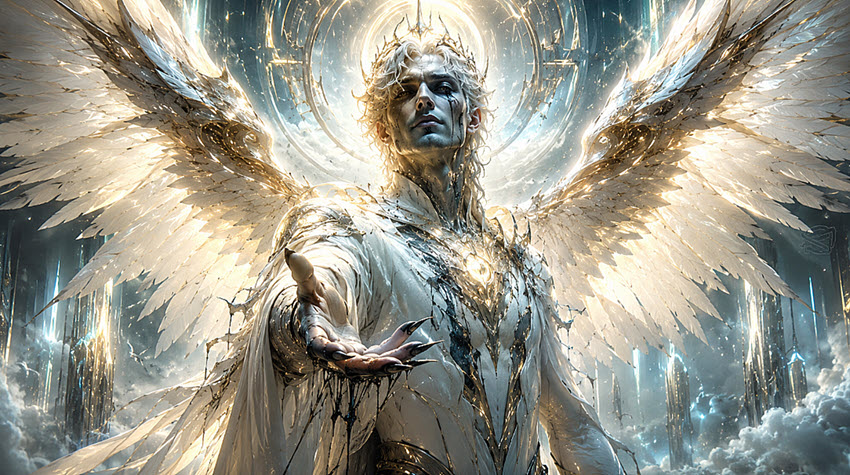
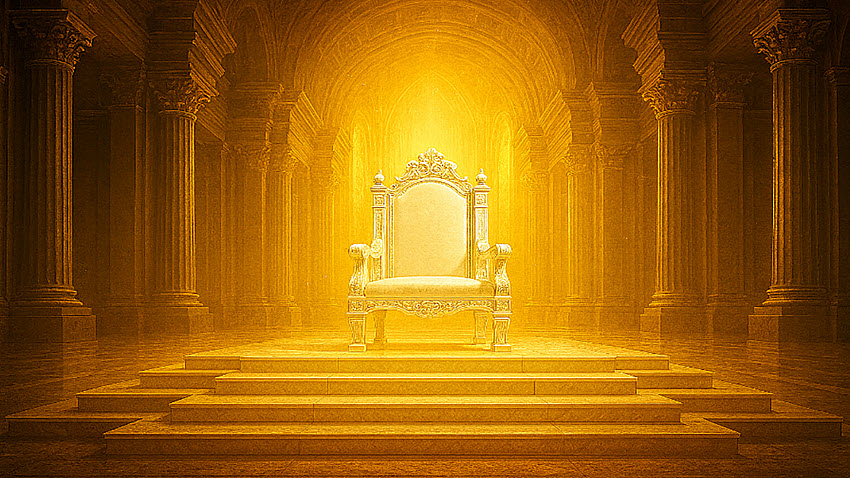
This alters the popular image of satan. The Bible does not speak here of a red figure with horns. Paul warns that satan can present himself as an angel of light.
The Greek verb points to a change of form or presentation—the adoption of a specific appearance. In other words, satan does not need to look terrifying. He can appear handsome, trustworthy, pleasant, or even beautiful—like an angel of light. He can give the impression of a being who brings light. That is precisely why the deception of the world is so effective in every sphere, and most potent within religions.
2.5 Who exactly is satan?
Revelation lists several of his names in a single verse.
The ancient serpent, the devil, and satan:
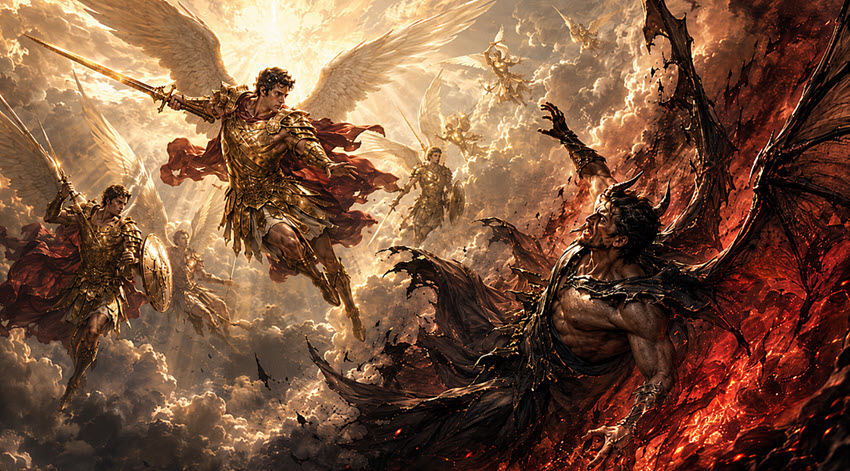
“And the great dragon was hurled down—the ancient serpent called the devil and satan, who deceives the whole inhabited earth. He was hurled down to the earth, and his angels were hurled down with him.” — Revelation 12:9.
In one place, we have:
• a great dragon,
• an ancient serpent,
• the devil,
• Satan.
„Satan” means adversary. „Devil” points to a slanderer—one who levels accusations.
Revelation adds yet another function: „who deceives the whole inhabited earth.”
This is a very good, concise description of who he is.
2.6 Satan is the adversary
Peter calls him exactly that—your adversary:
„Be sober, be vigilant. Your adversary, the devil, prowls around like a roaring lion, looking for someone to devour” — 1 Peter 5:8.
This term captures his role very well. He is: an adversary. He does not act for the good of God’s servants. He seeks opportunities to harm them. He lies in wait for our mistakes…
2.7 Satan appears before God:
„And it happened one day that the sons of God came to present themselves before YHWH, and among them came also the accuser” — Job 1:6.
This is a very important portrayal of satan. In the Book of Job, we do not see him only on earth.
He appears before God. Then, he begins to call Job’s faithfulness into question.
2.8 Satan accuses a person before God:
„Then the accuser answered YHWH and said: 'Does Job fear God for nothing?'” — Job 1:9.
Satan claims that Job serves God only because he receives benefits.
He questions his motives. He questions his sincerity. We see the same thing in Zechariah 3, where satan stands beside the high priest Joshua (Yeshu) to oppose him.
The Book of Revelation summarizes this activity even more forcefully:
„And I heard a loud voice in heaven saying: 'Now have come the salvation and the power and the Kingdom of our God and the authority of his Anointed One, because the accuser of our brothers has been thrown down, who accused them before our God day and night'” — Revelation 12:10.
This is one of the most important verses illustrating satan’s role.
The Bible calls him the accuser. This is not merely an inference drawn from the story of Job; Revelation states it directly: he accuses God’s servants before God.
2.9 Satan wants to put people to the test:
„Simon, Simon, behold, satan has demanded to sift you like wheat” — Luke 22:31.
This is a very interesting verse. Satan wants to subject the disciples to a severe test. He wants to shake them up. He wants to see who will endure. We see a similar picture in the story of Job. During the temptation of the Lord Yeshu, satan tries to induce Him to act against God. That is why the Bible calls him the tempter. His tactics include presenting a person with a path contrary to God’s will. He does not always begin with overt evil. At first, there may simply be a proposal. A temptation. A thought. A possibility.
Revelation 12:9 calls him the one „who deceives the whole inhabited earth.”
Deception is something different from an open attack. A deceived person often does not realize they have been misled; they may be convinced they are on the right path. This is why an earlier verse is so fitting here: satan disguises himself as an angel of light. He has persuaded people to worship deities not found in the teachings of Christ—such as through the veneration of images, the mother of God, the trinity, the false name „jesus,” and so on.
Not everything that looks like light comes from God.
2.10 Satan steals the word of God:
„Those along the path are the ones who have heard; then the devil comes and takes away the word from their hearts, so that they may not believe and be saved” — Luke 8:12.
Here, satan’s goal is stated very precisely.
A person has heard the word. The devil wants to take it away.
Why?
„So that they might not believe and be saved.”
This is one of the most important pieces of information regarding his activity.
2.11 Satan can influence a person’s heart:
„Peter said: 'Ananias, why has satan filled your heart to lie to the Holy Spirit and keep back for yourself part of the price of the field?'” — Acts 5:3.
Here we see Satan’s influence on a person. The result is a lie.
However, this does not mean that the person ceases to be responsible for their actions. Ananias remained accountable for his decision. He was tempted by satan but did not have to yield to his promptings; that is why he bore the consequences.
2.12 Satan hinders God’s servants:
“For this reason we wanted to come to you—I, Paul, more than once—but satan hindered us.” — 1 Thessalonians 2:18.
This is a very interesting verse. Paul wanted to do something. Satan hindered him. This means that the adversary’s activity also consists of hindering the work done for God.
2.13 Satan operates through methods and schemes:
„Put on the full armor of God, so that you may be able to stand against the schemes of the devil” — Ephesians 6:11.
The Greek word Paul uses here points to: methods, ways of operating, and schemes.
This must be remembered: satan does not work through just one type of temptation. He employs various methods. That is why it is necessary to know his way of operating.
2.14 Can satan do whatever he wants?
No.
The Book of Job shows very clearly that his capabilities are limited.
God sets a limit for satan:
„And YHWH said to the accuser: 'Look, everything he has is in your hand. Only do not lay a hand on the man himself'” — Job 1:12.
Satan wanted to “strike” Job. But he was not given unlimited power. God set a limit. This reveals something very important: satan is active, but he is not omnipotent. He is not equal to God. He cannot do whatever he pleases.
2.15 So why does satan exist?
The Bible does not give us a verse stating: „God created satan to tempt people.”
Nor does it say: „God needs satan.”
The Bible shows something else. satan exists. He is active. He opposes God. He accuses. He tempts. He deceives. He puts people to the test.
God allows him to act only within specific limits, as the Book of Job clearly demonstrates.
2.16 We undergo trials, but satan remains an adversary.
The story of Job reveals something very interesting. satan wants to destroy Job’s faithfulness. He wants to prove that a person serves God only for personal gain.
But ultimately, the trial reveals the opposite. Job undergoes a terrible ordeal, yet satan fails to prove what he set out to prove.
We see a similar picture in the words of the Lord Yeshu to Peter.
Satan wants to „sift [him] like wheat.”
Thus, God may allow a trial to take place. However, this does not mean that satan is working for the person’s good. His aim is the opposite.
2.17 Satan’s activity has an end
Satan will not operate indefinitely. Revelation shows his final judgment:
“And the devil who deceived them was thrown into the lake of fire and sulfur” — Revelation 20:10.
Satan will be annihilated forever. So why does he exist?
Perhaps to prove to spiritual and human beings that a world with evil people is being destroyed. If God did not intervene, they would destroy everything around them.
Conclusion
The Bible shows that satan is a spiritual being belonging to the created order.
He is not a second God. He is not equal to God. He does not possess unlimited power. The Bible does not say that God created him as an evil satan and told him to deceive people. One verse suggests that satan was perfect. At some point, he opposed God; that is why he is God’s adversary, a liar, an accuser, a tempter, and a deceiver.
His activity is very specific:
• accuses people before God,
• calls their faithfulness into question,
• puts them to the test,
• tempts,
• deceives,
• lies,
• steals away the word of God,
• influences people,
• hinders God’s servants,
• acts through deceit,
• seeks out people he can destroy.
He can also appear as an angel of light; therefore, evil does not always come in a terrifying form.
At the same time, the Bible shows the limits of his actions. Satan is not omnipotent.
God remains above him. Ultimately, satan and his agents will be annihilated…
Let us remember these verses:
“In whom the god of this age has blinded the minds of the unbelievers, so that the light of the good news of the glory of the Anointed One—who is the image of God—might not shine upon them” — 2 Corinthians 4:4.
“We know that we are from God, and the whole world lies in the power of the evil one” — 1 John 5:19.










Zapraszam do komentowania, wyrażania swojej opinii: